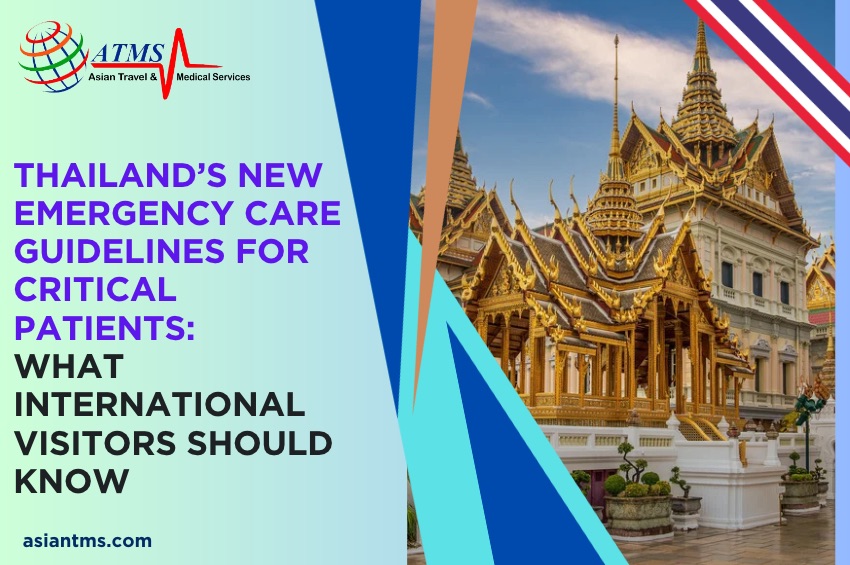
Thailand is bringing its emergency healthcare arrangement to life with improved guidelines for the treatment and financial support of critically ill emergency victims. In September 2026, Thailand’s Cabinet certified revised rules under the Universal Coverage for Emergency Patients (UCEP) foundation, strengthening requirements for prompt emergency care and ongoing care for critically ill patients.
For foreigners worldwide, understanding how Thailand’s emergency care system works may be valuable. At Asian Travel and Medical Services, our Medical Services provider in Thailand recognise that international travellers may need help with emergency medical arrangements, nursing home transfers, and other forms of medical support. Thailand’s most recent emergency care guidelines provide a framework to understand what happens when a celebrity requires immediate care.
What Are Thailand’s New Emergency Care Guidelines?
The revised UCEP tests were certified by Thailand’s Cabinet on 15 September 2026. The updated foundation is engaged to ensure that patients experiencing emergencies receive current treatment and continuing care, while establishing clearer processes for clinics, emergency supply instructions, and reimbursement.
Under the corrected tests, healthcare facilities must designate emergency treatment for critically ill patients immediately, in accordance with professional principles and the facility’s efficiencies.
What Is a Critical Emergency?
Thailand’s emergency care system uses triage to decide the severity and importance of a patient’s condition. A critical emergency mainly includes a condition that poses an immediate threat to life or vital bodily functions. Thailand’s emergency-care establishment focuses on a rapid approach to appropriate treatment for sufferers whose conditions deteriorate quickly without restorative intervention. You can contact ATMS for any kind of emergency medical help in Thailand.
Examples of serious emergency symptoms can include:
- Loss of consciousness or apathy
- Severe trouble breathing
- Sudden and severe chest pain
- Serious neurological syndromes
- Severe stress
- Acute conditions that warn of disruption of breathing or movement of the nervous system
Travellers should not attempt to decide their own condition. If a person experiences conceivably life-threatening manifestations, seeking emergency medical assistance could be the arrangement.
The Importance of Emergency Triage
Hospitals must have skilled healthcare professionals judge the severity of emergency subjects and provide care according to the urgency of their condition. Where there are questions about emergency classification, the relevant national emergency medical experts may be consulted.
Triage is the main reason emergency regions may receive many cases at the same time. The most precariously ill patients need to be identified quickly because life-saving treatment can begin without avoidable delay.
Up to 72 Hours of Continuous Emergency Care
One of the most meaningful facets of the revised UCEP tests is the support provided to the ongoing condition. Healthcare facilities must support care for critically ill emergency sufferers until they are no longer in a fault-finding condition and must continue care for the latent cause or manifestations of the fault-finding condition for up to 72 hours from admission under the particularized UCEP plans.
This is important cause critically ill sufferers may demand, in addition to immediate stabilisation. You can also hire our medical repatriation services provider in Thailand for any kind of help.
Can a Critical Patient Be Transferred?
Yes. The revised guidelines recognise circumstances in which a precariously ill emergency patient permits a transfer to another healthcare facility.
A transfer may be considered when the original facility does not have sufficient capability, when the patient is not more critically ill, and another facility is able to provide a special care facility for the elderly, or when the patient or their representative wishes to receive treatment somewhere, subject to the appropriate environment.
This is specifically having to do with medical conveyance. A journey might originally go to the nearest hospital because it is the most appropriate place for immediate emergency treatment. Once the patient has been stabilised, doctors grant permission and decide that further treatment is necessary at another facility.
In specific cases, safe and correctly matched patient transfer becomes a fundamental part of the overall medical-care journey.
Why Hospital Transfers Matter to International Visitors
Thailand has a varied healthcare network, ranging from local clinics to larger specialist hospitals. A visitor who is seriously ill in a country destination cannot necessarily be transferred to the best-equipped hospital to determine the appropriate course of action. Depending on the circumstances, a patient may need to be transported to another hospital.
This can involve miscellaneous considerations:
- The patient’s clinical stability
- The type of situation necessary
- Availability of specialists
- Distance between healthcare abilities
- Appropriate healing transportation
- Medical staff necessary throughout the transfer
- Communication between the sending and receiving wards
For an international patient, arrangements may be more complicated cause classification, appendages, or travel companions may be inexperienced with local healthcare processes.
Thailand has also encouraged its national approach to substance-emergency risk evaluation through unification of the WHO Quick and Immediate Risk Assessment findings into a national digital following and reporting method.
Conclusion
Thailand’s improved emergency-care directions represent a major development in the country’s approach to critically ill emergency patients. The foundation emphasises prompt assessment, professional triage, resumed care, and organized processes for patient transfers, with supplies limited to 72 hours of emergency care under the UCEP foundation.
For international patients, the key communication is plain: serious medical dangers demand rapid action and persuasive arrangement. You can also contact our Asian travel and Medical Assistance provider Thailand and talk to our experts for more information.