Introduction
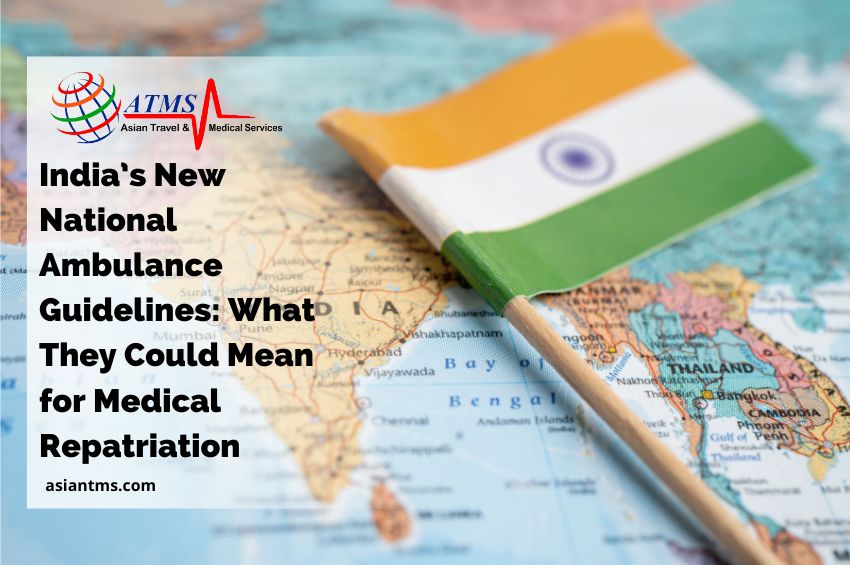
India has taken an important step towards better emergency medical transport following the launch of the Operational Guidelines on National Ambulance Services (NAS), 2026. Medical repatriation is not limited to the departure or the aircraft used to move a patient. It is a related journey that can start with a rescue transfer from a hospital, airstrip, or remote point and continue through several stages of health care.
At ATMS (Asian Travel and Medical Services), our medical repatriation services provider in India believes in the importance of this arrangement, especially when a patient needs to travel safely between healthcare facilities or return to their home country. The new transport framework helps create a stronger foundation for the ground-medical component of these journeys.
What are India’s New National Ambulance Guidelines?
The directions include:
- Quality of emergency transport services
- Accessibility to emergency transport
- Response efficiency
- Patient security
- Coordination between crisis duties and healthcare abilities
- Pre-clinic medical care
- Referral and patient-transfer plans
The foundation also advances greater use of science and standardised operating processes. For medical repatriation providers like us, these regions are specifically appropriate because trustworthy patient movement repeatedly depends on effective coordination before a patient reaches an airfield.
Why Ground Ambulance Services Matter in Medical Repatriation
When people think of “medical repatriation,” they may directly consider an air ambulance or a medically supervised commercial departure. However, ground conveyance is frequently an equally important part of the process.
A patient may need to be moved:
- From a local nursing home to a professional one
- From a hospital to an airport
- From an airport to a receiving hospital
- Between nursing homes during a general transfer
- From a remote area to an appropriate nursing home
Medical evacuation in India can include patients who require oxygen, mobility assistance, or continuous medical care. This is why we see the development of more consistent rescue standards in India as potentially significant. A medically appropriate vehicle and prepared crew can serve as a main link between various stages of a patient’s journey.
Standardisation Could Improve Patient Safety
One of the key items of the new directions is the necessity for ambulances to conform to AIS-125 guidelines. The government states this is intended to support consistency, safety and condition in emergency transport vehicles. For patient transfer, standardisation may be valuable cause patient transfers may include diverse organisations and locations.
Better Coordination Through Technology
Another main feature of the NAS 2026 foundation is the projected use of Integrated Command and Dispatch Centres (ICDCs). These centres are engaged to support functions like GPS-enabled ambulance tracking, call management, organized response, standardised dispatch, and real-time monitoring.
The directions also boost seamless integration of rescue duties accompanying India’s unified emergency number 112. For crisis transfers, better digital arrangements could make it easier to find suitable funding and route an ambulance throughout the journey.
For our medical services provider in India, communication and coordination are important for healing repatriation. A patient transfer can involve hospitals, doctors, ambulance teams, airports, airlines, medical escorts, and taking facilities. Improvements in India’s more scattered emergency transport foundation take care of form arrangement between these stages more efficient.
What Could This Mean for International Travellers?
India welcomes heaps of international visitors, containing visitors, business travellers, scholars, expatriates, and subjects pursuing medical treatment. Medical crises can take place surprisingly. A traveller may suffer a calamity, develop a sudden malady, or require ward treatment that makes immediate commercial travel unfit.
In these situations, restorative repatriation may be an option once the patient is medically assessed and appropriate plans are made. We can help coordinate the different components difficult in such transfers, including medical information, hospital communication, ground transportation, and travel plans, depending on the patient’s individual lifestyle.
Medical Repatriation Is More Than Transportation
It is important to believe that medical repatriation is not simply about organizing a bicycle or flight.
An appropriate repatriation plan can involve:
- Reviewing the patient’s healing condition
- Communicating with the treating nursing home
- Assessing fitness to travel
- Determining the appropriate method of transportation
- Arranging ground ambulance transfers
- Coordinating healing escorts when necessary
- Communicating with the receiving nursing home
- Coordinating installation transfers
- Ensuring progression of care during the journey
Every patient is different. Someone resistant and mobile grant permission has very different transport requirements from a patient who needs ongoing monitoring or expert medical support.
What Should Families Consider During a Medical Emergency?
Families may need to ask:
- Is the patient medically stable?
The medical crew should assess whether the patient may be moved.
- What type of transport is appropriate?
Depending on the condition, this could be a standard ambulance, chief medical transport, or another acceptable alternative.
- Is a medical escort compulsory?
Some patients can require restorative supervision during transport.
- Where should the patient be moved?
The receiving facility needs to be appropriate for the patient’s medical needs.
Conclusion
At Asian Travel and Medical Services, our Medical Assistance provider India understands that repatriation demands cautious preparation and arrangement at every stage. As India’s emergency transport infrastructure continues to develop, more effective standards and better coordination help us and different healthcare providers coordinate safer, more direct patient transfers.
Ultimately, the goal remains unchanged: helping victims receive appropriate curative support while ensuring that all stage of their journey is carefully managed. You can also contact our experts at ATMS for more advice.